Visual Essay
How Your Mind Shapes Your Future
Visualization, self-image, attention, and behavior
Equal talent can still produce radically different outcomes because attention, prediction, and identity alter what people notice and attempt.
Attention does not show you everything. It selects.
Three Core Ideas
Attention
You notice what your mind is prepared to see.
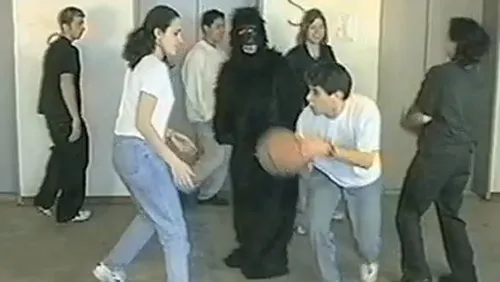
46% missed it
Even when it was in plain sight.
Prediction
Expectations shape how reality feels.
GYM
future me
momentum
one step
GYM
exhausting
judgment
too hard
Identity
Self-image influences what actions feel natural.
Speech
Fitness
Studiousness
Avoidance
46% vs 15%
Affirmed low-income participants were more likely to take benefits information.
46% of affirmed low-income participants took the benefits flier vs 15% in the neutral group.
Your brain predicts before it reacts.
Expectations shape perception, attention, and action.
264 low-income 8th graders
Possible-selves intervention: gains lasted 2 years.
Reinforcing Loop
Loop
Attention <-> Prediction <-> Identity
These systems can trap you in threat detection or train you to notice possibility.
Visualization That Works
Wish + obstacle + if-then plan
More effective than positive fantasy alone.
1
[ ]
Future Self
Who am I becoming?
->
2
(*)
Attention
What would that person notice?
->
3
/!\\
Obstacle
What will pull me back?
->
4
->
If-Then Plan
If that happens, what will I do?
Applications for Independent Living After College
Courageous Self
Future Self:I am someone who moves with direction, even through uncertainty.
Attention:I notice openings to speak up, reach out, and take the next brave step.
Obstacle:I feel scared of rejection, failure, being judged, or not knowing what comes next.
If-then:If fear makes me want to shrink, then I will take one brave next step before overthinking it.
Healthy Self
Future Self:I am someone who takes care of my body and mind.
Attention:I notice how what I do effects energy, stress, and body, and long-term outcomes.
Obstacle:When it comes time to workout, I just want to lay in bed
If-then:If it is time to work out and I just want to lay in bed, then I will go to the gym and do one set. After that, I can leave if I want to.
Independent Self
Future Self:I am someone who takes care of my time, money, and responsibilities
Attention:I notice deadlines, spending, and small responsibilities before they snowball.
Obstacle:I get overwhelmed and avoid responsibilities.
If-then:If I feel overwhelmed, then I will take five deep breaths and complete one small task before doing anything else.
Closing
You can let fulfillment, relationships, growth, health, freedom, and opportunity slip by, while setbacks, rejection, comparison, fear, stress, and doubt dominate attention.
What are you training yourself to notice?
Sources
Predictive Brain
Friston, K. (2010). The free-energy principle: a unified brain theory?
Nature Reviews Neuroscience, 11, 127-138.
Used for: Predictive brain / prediction and prediction error.
nature.com/articles/nrn2787Selective Attention
Desimone, R., & Duncan, J. (1995). Neural Mechanisms of Selective Visual Attention.
Annual Review of Neuroscience, 18, 193-222.
Used for: Selective attention as limited-capacity processing.
ucsd.edu/.../04.09-VisAttnRev.pdfSimons, D. J., & Chabris, C. F. (1999). Gorillas in our midst: sustained inattentional blindness for dynamic events.
Perception, 28(9), 1059-1074.
Used for: Inattentional blindness / gorilla study.
pubmed.ncbi.nlm.nih.gov/10694957Hall, C. C., Zhao, J., & Shafir, E. (2014). Self-Affirmation Among the Poor: Cognitive and Behavioral Implications.
Psychological Science, 25(2), 619-625.
Used for: 46% vs 15% benefits-information result.
princeton.edu/.../self_affirmation_among_poor.pdfSelf-Image
Markus, H., & Nurius, P. (1986). Possible Selves.
American Psychologist, 41(9), 954-969.
Used for: Possible selves theory and identity-based motivation.
researchgate.net/.../Possible-Selves.pdfOyserman, D., Bybee, D., & Terry, K. (2006). Possible Selves and Academic Outcomes: How and When Possible Selves Impel Action.
Journal of Personality and Social Psychology, 91(1), 188-204.
Used for: Possible selves linked to strategies and action.
stanford.edu/.../oyserman_byeee_terry_2006.pdfVisualization That Works
Oettingen, G. (2013). Future thought and behaviour change.
European Review of Social Psychology, 23(1), 1-63.
Used for: Mental contrasting: desired future plus present obstacle.
pmc.ncbi.nlm.nih.gov/articles/PMC3759023Duckworth, A. L., Kirby, T. A., Gollwitzer, A., & Oettingen, G. (2013). From Fantasy to Action: Mental Contrasting With Implementation Intentions (MCII) Improves Academic Performance in Children.
Social Psychological and Personality Science, 4(6), 745-753.
Used for: If-then planning combined with mental contrasting.
pubmed.ncbi.nlm.nih.gov/25068007